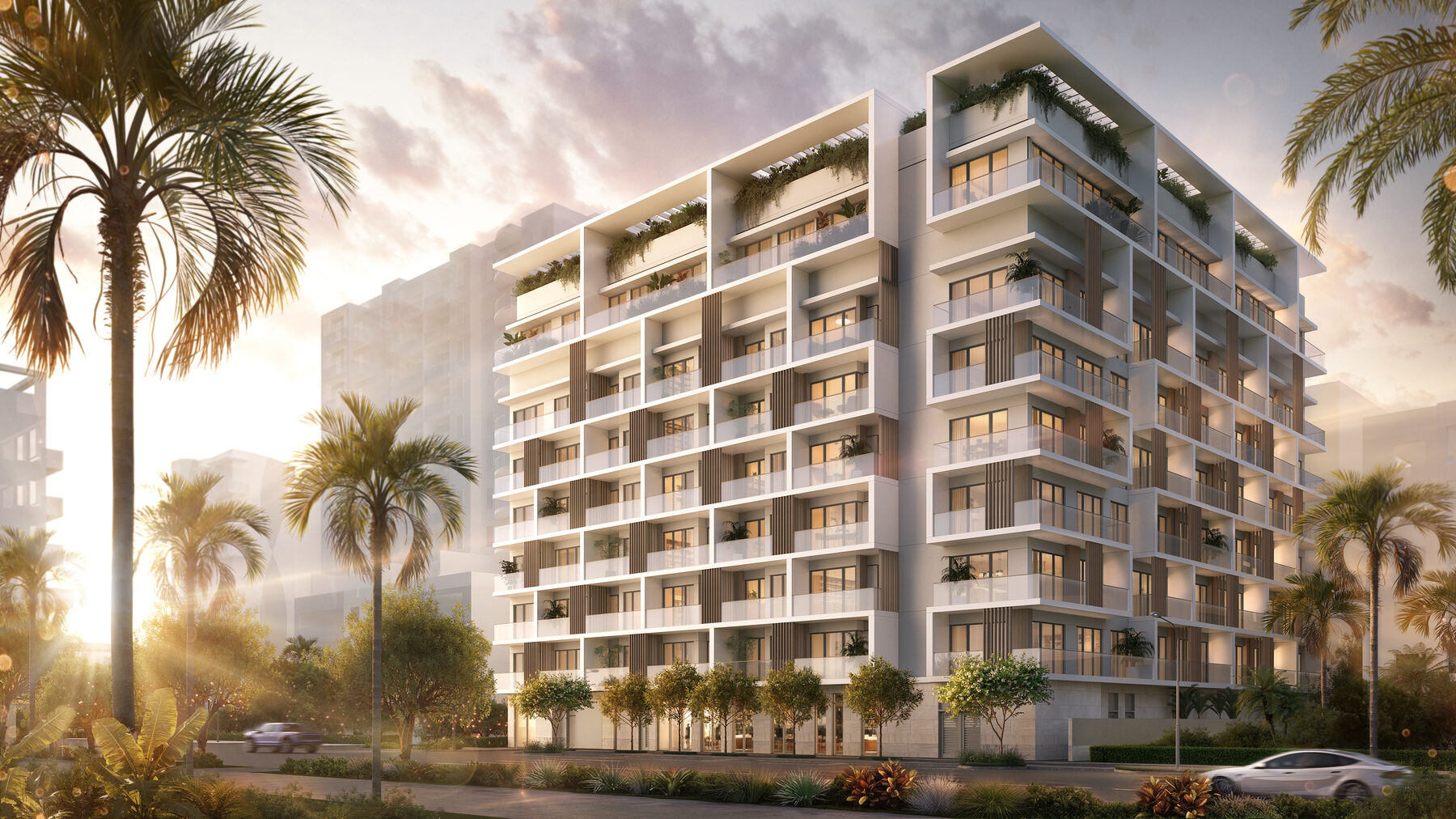
The first thing you notice about the Parkside renderings is what is not there. There is no soaring cantilever. There is no podium of polished onyx. There is no twenty-story glass atrium designed to be photographed from the sidewalk across the street. The building is eight stories tall, horizontal in proportion, white in its mass, and softened throughout by planted balconies and warm timber fins. It reads less like a statement and more like a proposition — a quiet suggestion that Miami, at this stage in its maturity, does not need to keep shouting.
Parkside is the latest residential commission from Kobi Karp, an architect whose Miami portfolio now spans roughly three decades and includes some of the most visible additions to the city's skyline. Karp's office has designed the Baccarat Residences in Brickell, interior work at the Ritz-Carlton Residences, residential towers along the Miami River, and numerous mid-block buildings in the broader Miami-Dade residential market. The firm is unusually productive and unusually versatile; the same practice can deliver a forty-story luxury tower and a six-story boutique condominium in the same year.
What is interesting about Parkside within that portfolio is that it belongs to the quieter category — not the flagship, not the trophy, but the carefully designed mid-scale residence that demonstrates the firm's command of restraint. This is not a building that is trying to stand out in Brickell. It is a building that is trying to disappear into Brickell in the best sense of the word: to participate in the neighborhood rather than to announce itself.
A low-rise in a district of towers
The first deliberate decision of the architecture is the height. Brickell's residential stock skews vertical: towers between thirty and fifty stories are the dominant typology, and a new arrival of fewer than twenty floors is somewhat unusual. Parkside is eight. That decision shapes everything that follows. Because the building is low, it does not need to be sealed. Because it does not need to be sealed, it can open. Because it can open, the balconies become meaningful.
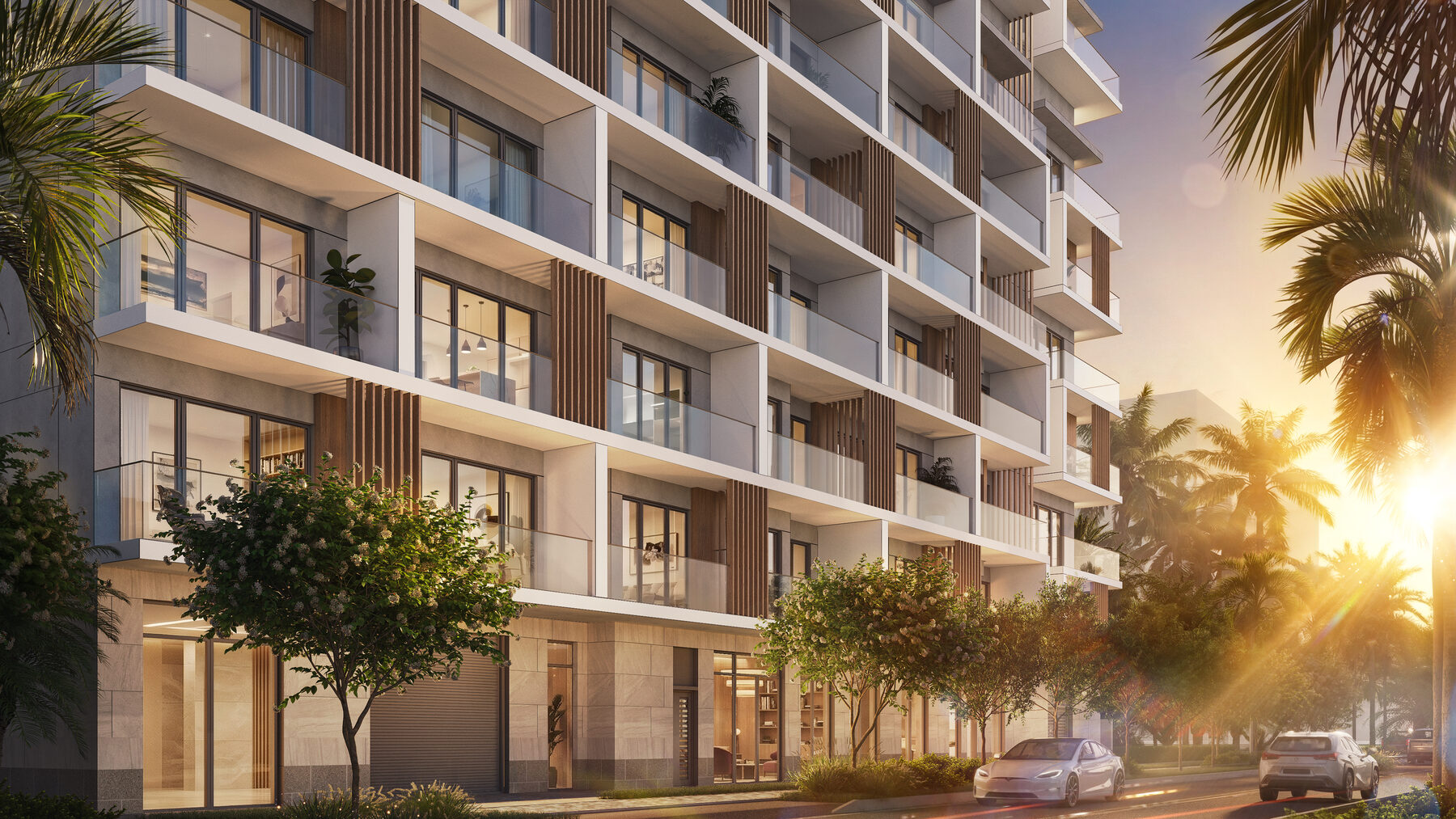
Every Parkside residence has a private balcony, enclosed only by a glass railing and planted at the edges. These are not vestigial balconies designed to satisfy a code requirement — they are balconies large enough to hold a small table, a planter, a morning coffee. The exterior rendering makes this visible: the facade reads as a layered collection of private outdoor rooms rather than a sheer glass wall.
"A low-rise building in Miami is a harder brief than a tower. The facade cannot rely on height for drama. It has to earn its presence through detail."— Editorial reading, not a direct quote from the architect
The detailing earns its presence through a disciplined material palette: white concrete mass, bronzed metal for the railing and window frames, warm timber for the balcony fins and soffits, and substantial planted greenery integrated into the facade itself. The effect is Mediterranean rather than Miami Modern. The building reads less like a product of 2020s Brickell and more like a residential block you might encounter in Lisbon, Naples, or the quieter streets of São Paulo.
The interior language
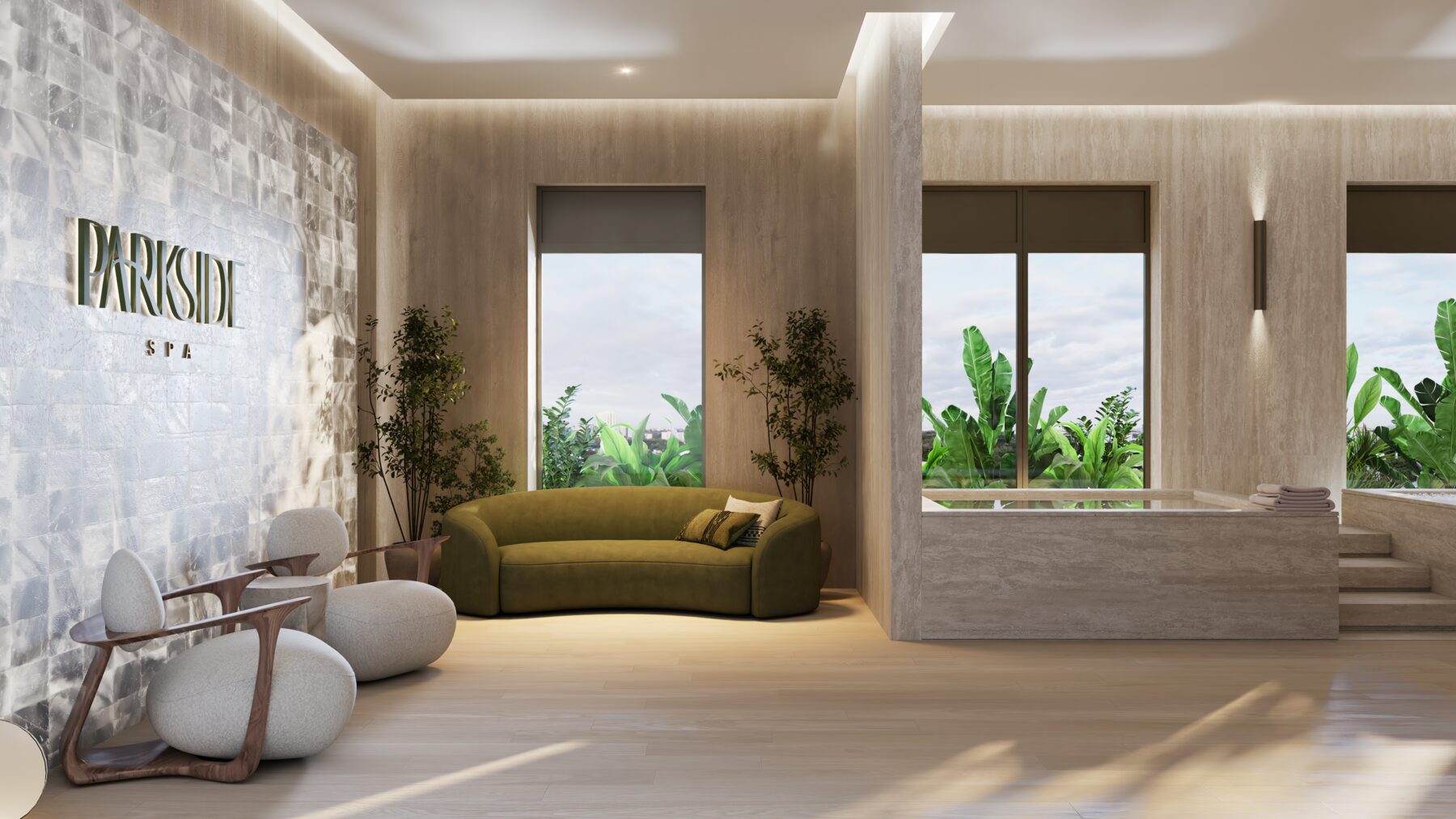
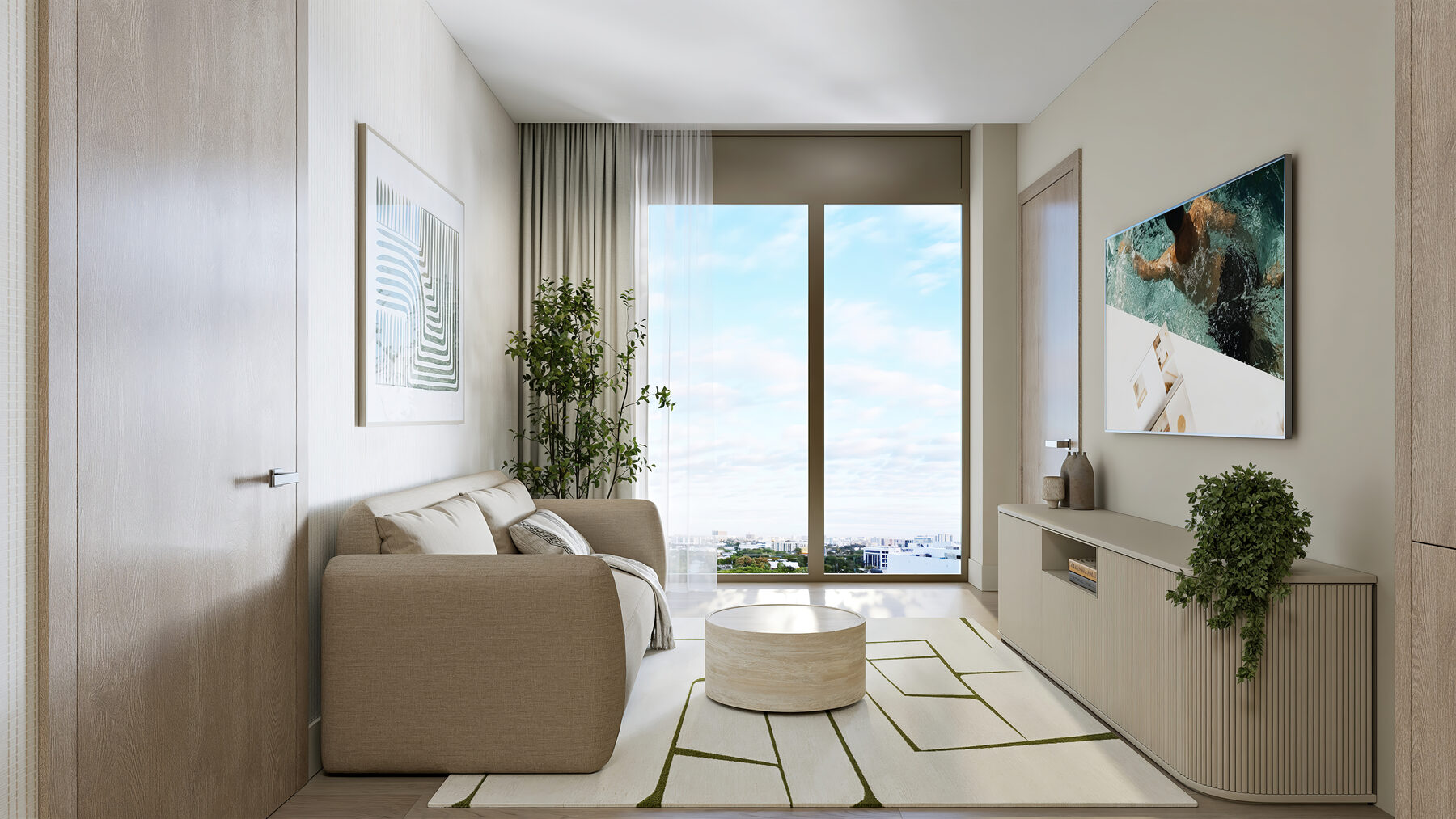
Inside, the vocabulary continues. The interior package specifies Italkraft cabinetry — an Italian manufacturer with a long Miami presence — with upper cabinets, quartz countertops, and full-height quartz backsplashes. The plumbing is Kohler throughout. The appliance program is Bosch. The floors are uniform, the ceilings are finished, the millwork is built-in rather than free-standing. A modern furniture package is included in every residence. Owners arrive to a finished apartment.
The move toward fully-finished, fully-furnished delivery is significant in the Miami market. Historically, Brickell residences have shipped either fully bare — concrete floors, unfinished ceilings, no appliances — or fully white-box, with the expectation that the buyer would commission their own interior designer after closing. Parkside belongs to a newer category in which the interior package is pre-specified, pre-curated, and delivered installed. It is a logical response to the actual behavior of the Miami buyer: many of these residences will be used as part-time homes, short-term rentals, or second residences, and the buyer does not necessarily want to manage a six-month finishing project from abroad.
The amenity floor as civic space
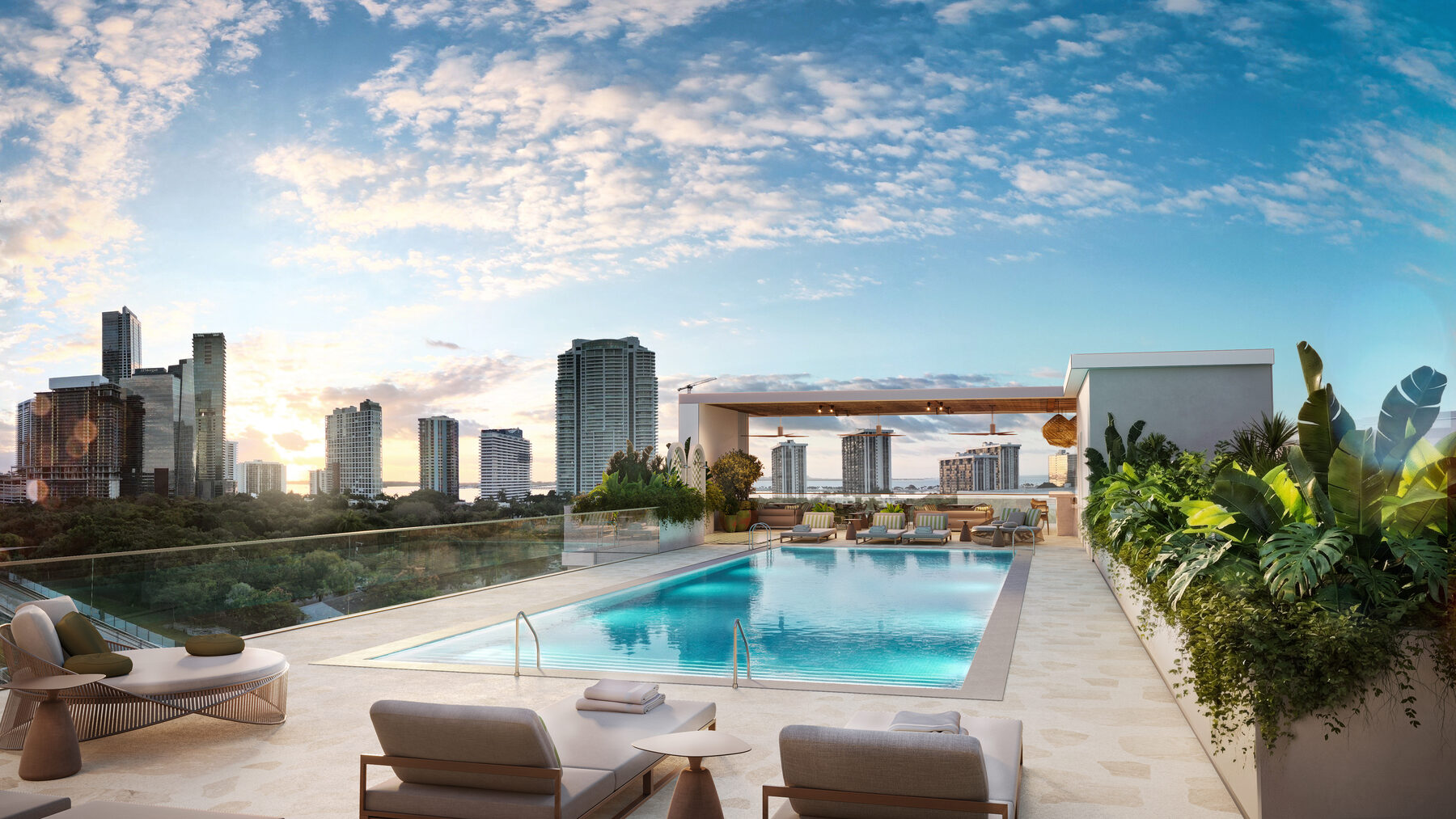
The rooftop is the building's most deliberate architectural gesture after the facade. An eight-story building gives you an amenity deck at the height where a pool is still legible from the street but where the view extends meaningfully over the surrounding blocks. The rooftop program includes a pool, an outdoor BBQ kitchen, a rooftop bar, a zen garden, and the adjacent spa circuit with sauna, steam room, hot and cold plunges, and a salt relaxation zone.
What makes the rooftop useful as architecture is that it is not merely a photograph opportunity — it is sized for daily use. The beach-inspired pool deck is shaped for lounging rather than theatrical diving. The BBQ kitchen is configured for small dinners rather than catered events. The zen garden is enclosed and quiet. These are gestures of a building designed to be lived in, not staged in.
The Technogym dimension
The wellness program deserves a specific note. The Parkside fitness floor includes a full Technogym cardio and strength center, a dedicated Technogym cycling studio, and a yoga studio. Technogym, as a brand, signals an upscale institutional standard — the equipment is what you would expect to find at a private club or a high-end boutique gym, not at a residential amenity deck. The decision to specify Technogym across three distinct fitness programs (cardio/strength, cycling, yoga) reflects the architect and developer's working assumption that the Parkside resident will use the gym regularly, daily, and with some seriousness.
A working definition of luxury
If Parkside has a thesis, it is something like this: luxury in 2026 is not defined by spectacle. Luxury is defined by the absence of friction. The building is finished, so you do not manage a construction project. The residence is furnished, so you do not coordinate an interior designer. The amenities are institutional-grade, so you do not maintain a membership elsewhere. The rentals are permitted, so you do not navigate a board. The architecture is restrained, so you do not live inside a landmark.
This is a quieter definition of luxury, and it is a useful one. It is the definition that most of the Parkside prospects — internationally mobile, time-constrained, frequently working across time zones — will recognize as the one they actually want.
The building does not try to impress you at the curb. It tries to be the residence you walk into after a long trip, drop your bag, open the balcony door, and stop noticing. That is a difficult thing to design. It is the thing Parkside has set out to do.
 Neighborhood · 7 min read
 Investment · 9 min read
 Availability